Home

Study Guide 1: Understanding Informal Settlements and Slum Upgrading [Document | Photo Gallery]

ABOUT US

“The terms ‘urban development’ and ‘urbanization’ often conjure up vast, undeveloped spaces or slums. At I2UD, we simply recognize an underserved need that demands our attention.”

-John Driscoll, I2UD Vice President

The Institute for International Urban Development (I2UD) is a not-for-profit institution dedicated to improving urban environments for vulnerable communities, by providing research on spatial development issues, advisory services to city leaders, and urban planning education programs. 

Established in 2005, the Institute for International Urban Development (I2UD) regrouped the academics and professionals who created and ran the Center for Urban Development Studies (CUDS) from 1987 to 2005. The Center (CUDS) at Harvard University’s Graduate School of Design was internationally recognized for applied research, advisory services, technical assistance to policy makers, and capacity building programs.

The I2UD Library is an educational database of 40+ years of urban planning research, designed to facilitate a global perspective of urban planning history for a broad, diverse public audience. The Library is coupled with an archival photography collection, The I2UD Photography Galleries, documenting urban development conditions for vulnerable communities, in over 13 countries.

Development of The I2UD Library is supported through I2UD Board contributions. Our past activities have been funded by local and national governments, foundations and international organizations. Past partners and sponsors include The World Bank, UN-Habitat, USAID, the Inter-American Development Bank, Swedish International Development Cooperation Agency, Aga Khan University, the Christensen Fund, the Jordanian Royal Scientific Society and the Peter Sager Wallenburg Charitable Trust.

Our current AI Climate Platform initiative is supported by the Patrick J Mc Govern Foundation Accelerator Grant, I2UD Board members and an AI for Earth Microsoft Azure Compute Grant. The Patrick J. McGovern Foundation has included I2UD in their donation program, providing digital access to high resolution satellite images for our AI Climate Platform project.

The Patrick J. McGovern Foundation is a global 21st century philanthropy bridging the frontiers of artificial intelligence, data science, and social impact to create a thriving, equitable and sustainable future for all. The Foundation’s work focuses on bringing together academia, practitioners, and civil society to pursue the potential of AI and data science to address some of the world’s most urgent challenges.

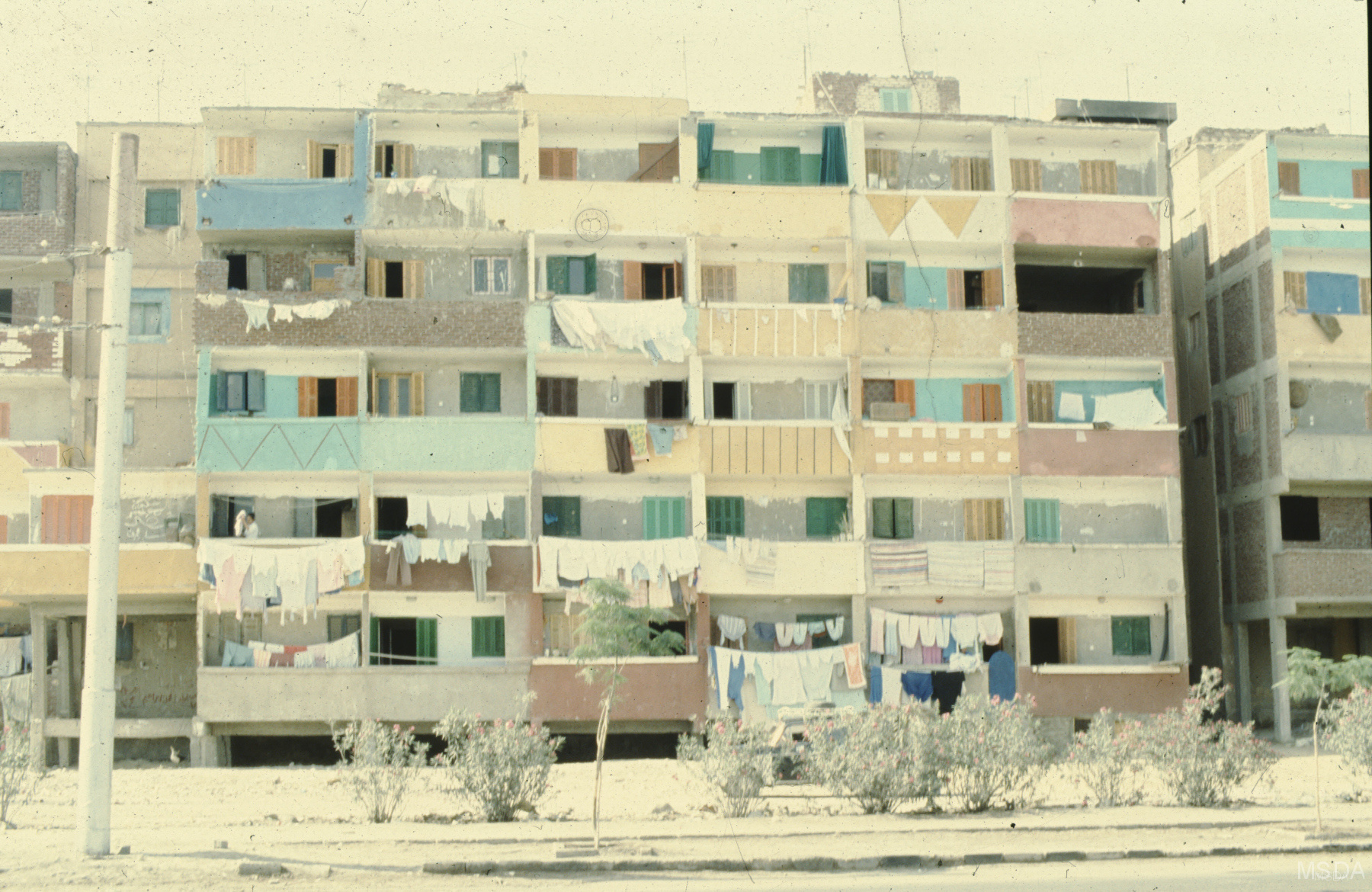
Public housing in Helwan, Cairo, Egypt. August 1985. MSDA/I2UD Slide Collections. M01, Egypt, Cairo, 44-012. Original series: “Urban Fringe – Informal Housing: Public Housing Helwan.” The Institute for International Urban Development. Digitized 2022.

AI Climate Platform

AI Climate: A Decision Making Tool for Climate Resilience: USING AI TO IDENTIFY CLIMATE CHANGE HAZARDS IN THE CITIES OF THE GLOBAL SOUTH

AI Climate Platform is a land management and decision-making tool geared to Global South cities that lack local data. Its objective is to use advanced Artificial Intelligence (AI) techniques and freely available satellite images to cut the time and expense involved in mapping, monitoring, and predicting exposure to shocks and stresses in fast urbanizing smaller cities of the Global South.

Our ongoing development effort for AI Climate uses data from Tegucigalpa and San Pedro Sula, the two largest urban areas in Honduras, Central America. Climate change in Honduras is increasing the frequency and strength of tropical storms and hurricanes, impoverishing farmers and pushing them to settle in informal urban settlements, which are also at risk from climate change. AI Climate builds on a long record of innovative technology use at I2UD, such as our pioneering use of remote sensing and machine learning in Arusha, Tanzania, in 2013.

Our technical partner, Dymaxion Labs, has garnered extensive experience in applying AI to remote sensing—recognizing patterns in satellite and aerial images—since its founding a few years ago in Buenos Aires, Argentina. Dymaxion Labs is incrementally developing tools to account for hazards ranging from flooding to heat islands and the location of socially vulnerable communities in Honduras.

AI Climate is conceived as a platform that will offer an integrated tool to identify significant risks from climate change affecting poor urban communities. I2UD’s AI-Climate Platform is a response to two significant trends:

The combination of impacts of climate change, fast expansion of informal settlements, and budgetary and trained-personnel limitations

Rapidly increasing geospatial imagery availability and falling processing costs

Press Update – 10/20/2022:
“Planet Launches Nonprofit Program to Empower Mission-Driven Organizations with More Access to Timely, Global Satellite Data”

Planet is putting together a new, standardized program aimed at providing significant amounts of highly discounted imagery to NGOs and nonprofits. The launch of Planet’s Nonprofit Program will feature the collaboration with I2UD and Dymaxion Labs have been doing with mapping informal settlements in Honduras using PlanetScope imagery.

[Excerpt:] “In line with Planet’s mission to use space to help life on Earth and in effort to enable more impactful uses of Planet’s data, the offering addresses two traditional challenges facing nonprofits – limited budgets and resources, and the infrastructure and technical expertise to analyze the data. The goal is that by providing more accessible data products and technical support services, the Nonprofit Program will help users better extract information and create applications that power decisions and enable action.”

“The work I2UD completed [is in] collaboration with Dymaxion Labs, Habitat for Humanity Honduras, GOAL Honduras, and the Honduran Institute of Earth Sciences (IHCIT), in partnership with the Data and Society Accelerator Program from the Patrick J. McGovern Foundation, which introduced Planet to I2UD.”

“The team improved and evolved a land management and decision-making tool geared to Global South secondary and tertiary cities that lack quality and up-to-date local data to monitor exposure of informal settlements and low-income communities to severe and extreme weather impacts. The tool, AI Climate, processes geospatial images and geo-referenced datasets and derives analytics-ready layers of impacts associated with climate change. I2UD is improving and developing layers to identify flooding and landslide risks, informal urbanization, and land value differentials.”

“By using PlanetScope basemaps, I2UD and its partners were able to map vulnerable communities in Tegucigalpa and Sula Valley in Honduras. Compared to previous satellite data platforms, the project analysts found PlanetScope basemaps performed significantly better in both geographies based on intersection of ground truth (IoGT) data, with fewer noisy predictions, and a bigger size of image could be fed into the neural network.”

“Since both climate change and socially vulnerable communities, including informal settlements, are moving targets, it is imperative to aim for speed and frequent updates to make risk information available to those communities as well as planners and policy makers in fast-urbanizing cities; our goal is to use just enough information to keep AI Climate economical and agile but still with good quality prediction,” said Alejandra Mortarini, Vice President, I2UD.”

“An essential part of the I2UD AI Climate platform is to incorporate local partners and communities’ knowledge of their own conditions to ensure that community organizations can make sense of the platform’s findings, and are able to use those outcomes for their own benefit. “The combination of Planet’s higher resolution images, AI technology, and ground truth provided by local partners create a powerful tool for effective city resiliency co-production,” Alfredo Stein, University of Manchester, UK, Senior Advisor to AI Climate, explained.”

“That is why Planet’s imagery was key in providing higher resolution to better create local data for local partners,” Carlos Rufin, President, I2UD, continued. “The cost of higher-resolution imagery is typically unattainable for nonprofits. By providing highly discounted imagery to NGOs and nonprofits, Planet could make a difference in so many dimensions.”

______________

This initiative is a response to two significant trends: On the one hand, the combination of impacts of climate change, fast expansion of informal settlements, and budgetary and trained-personnel limitations, especially in secondary and smaller cities; and on the other, rapidly increasing geospatial imagery availability and falling processing costs, which make it possible to cut time, expense and improve quality of documentation to craft policies, spatial plans, and interventions aiming at safer, resilient cities.

Community involvement is a crucial need in contexts of the limited capacity of local governments to produce relevant data and address local hazards. AI Climate also incorporates a community inclusion, validation, and mapping processes, to integrate local knowledge and to help communities make sense of AI results and put them to use effectively.

In 2020, we received seed money from I2UD Board Member Sherif Lotfi to start a Proof of Concept of the AI Climate tool. At present, a $10,000 in-kind grant from Microsoft’s AI for Earth Program, and a $100,000 Accelerator Grant from the Patrick J. McGovern Foundation, are allowing us to improve and develop capabilities to identify flooding and landslide risks, informal urbanization, and land value differentials. Our vision is that AI Climate will help plan strategies for climate change adaptation and mitigation in cities through participatory processes that include free, equitable access to the tool.

Technically, AI Climate processes geospatial images and geo-referenced datasets and derives analytics-ready layers of climate impacts such as flooding and landslides. Our methodology for developing AI Climate is based on supervised learning techniques, combining the availability of global and local data to calibrate the precision of the models regarding the different data sources and their acquisition cost. All software involved is open source to ensure that the AI Climate Platform is widely accessible to many cities and communities in the Global South that lack the resources to carry out regular and comprehensive hazard identification.

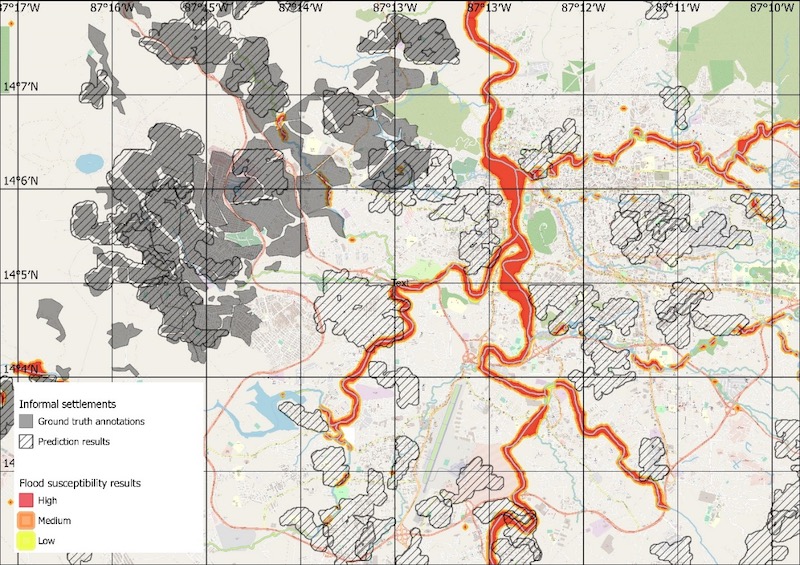
To illustrate how AI Climate works, the image below provides a synthesized graphic of our current development effort’s first round of predictions. It shows a section of Tegucigalpa with the actual areas of socially vulnerable communities we have identified (“ground truth annotations”), the actual communities identified by our algorithms “prediction results”, and also our flooding risk prediction results.

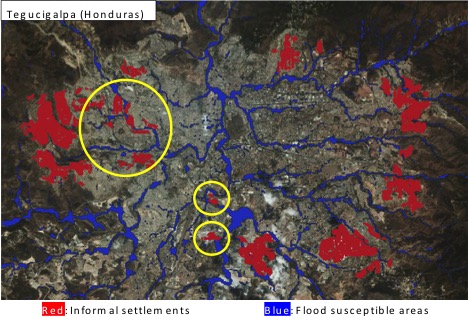
AI Climate generated map showing informal settlements (Red) and flood susceptibility regions (Blue) in Tegucigalpa, Honduras.
Map of socially vulnerable communities in Tegucigalpa, Honduras, Central America, showing Informal settlements, “Ground truth” annotations, Prediction results, and Flood susceptibility results. I2UD/Dymaxion Labs, 2022.


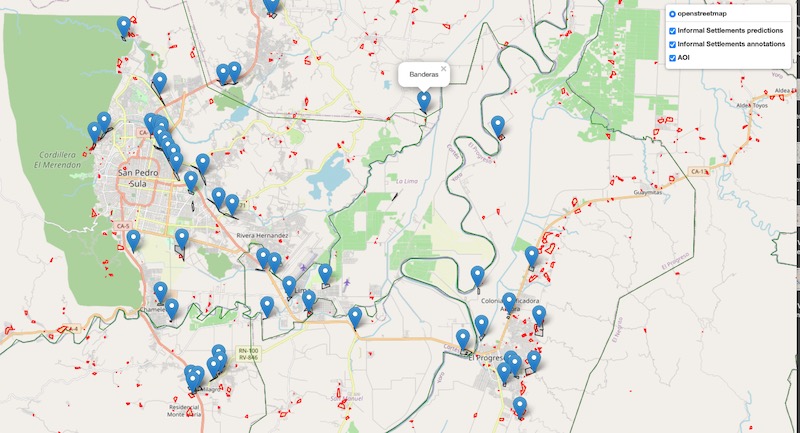
To find the “ground truth” that we need for the machine learning process underlying AI, we work closely with partner organizations in Honduras. The image below shows a snapshot of the interactive map of the Honduras San Pedro Sula region we have developed with our partners. The ground truth data input is represented by the blue pins, indicating the presence of socially vulnerable communities. The red polygons denote our initial predictions about the location of these communities. Comparing both indicators facilitates validating our results by local experts and communities.

Map of socially vulnerable communities in the Sula region, San Pedro, Honduras, showing ‘ground truth’ (blue pins), compared to AI-generated predictions (red polygons). I2UD/Dymaxion Labs, 2022.

Additionally, we have sought to use both satellite images in the public domain and higher-resolution images typically available from commercial sources only to improve the quality of our expected outcomes. Given the high cost of the latter, our approach has been to build relationships with commercial suppliers to request philanthropic use of a limited set of their images, given the non-profit nature of our organization and the project objectives.

With the help of the Patrick J. McGovern Foundation, we are working with a major global provider of high resolution satellite images, Planet, which has agreed to include us in their donation program. The Patrick J. McGovern Foundation is a global 21st century philanthropy bridging the frontiers of artificial intelligence, data science, and social impact to create a thriving, equitable and sustainable future for all. The Foundation’s work focuses on bringing together academia, practitioners, and civil society to pursue the potential of AI and data science to address some of the world’s most urgent challenges.

An essential part of our project is to incorporate local communities’ detailed knowledge of their conditions and to ensure that they can make sense of the findings and use them or their benefit. In Honduras, our approach relies on local partners that are well established in that area, produce high-quality work, and understand and value the nature and objectives of AI Climate. These include Habitat for Humanity, GOAL, and the Honduran Institute of Earth Sciences (IHCIT), and technical advisors Alfredo Stein and Carlos Rivas. These organizations’ prior work and long-standing local presence mean that they have strong connections with local communities, which will allow us to verify AI Climate’s predictions at the community level.

In sum, the AI Climate Platform is an exciting new step in the Institute’s long-standing commitment to bringing cutting-edge technology to the most excluded urban communities of the Global South.

Stay tuned as we share further updates on our AI Climate Platform!

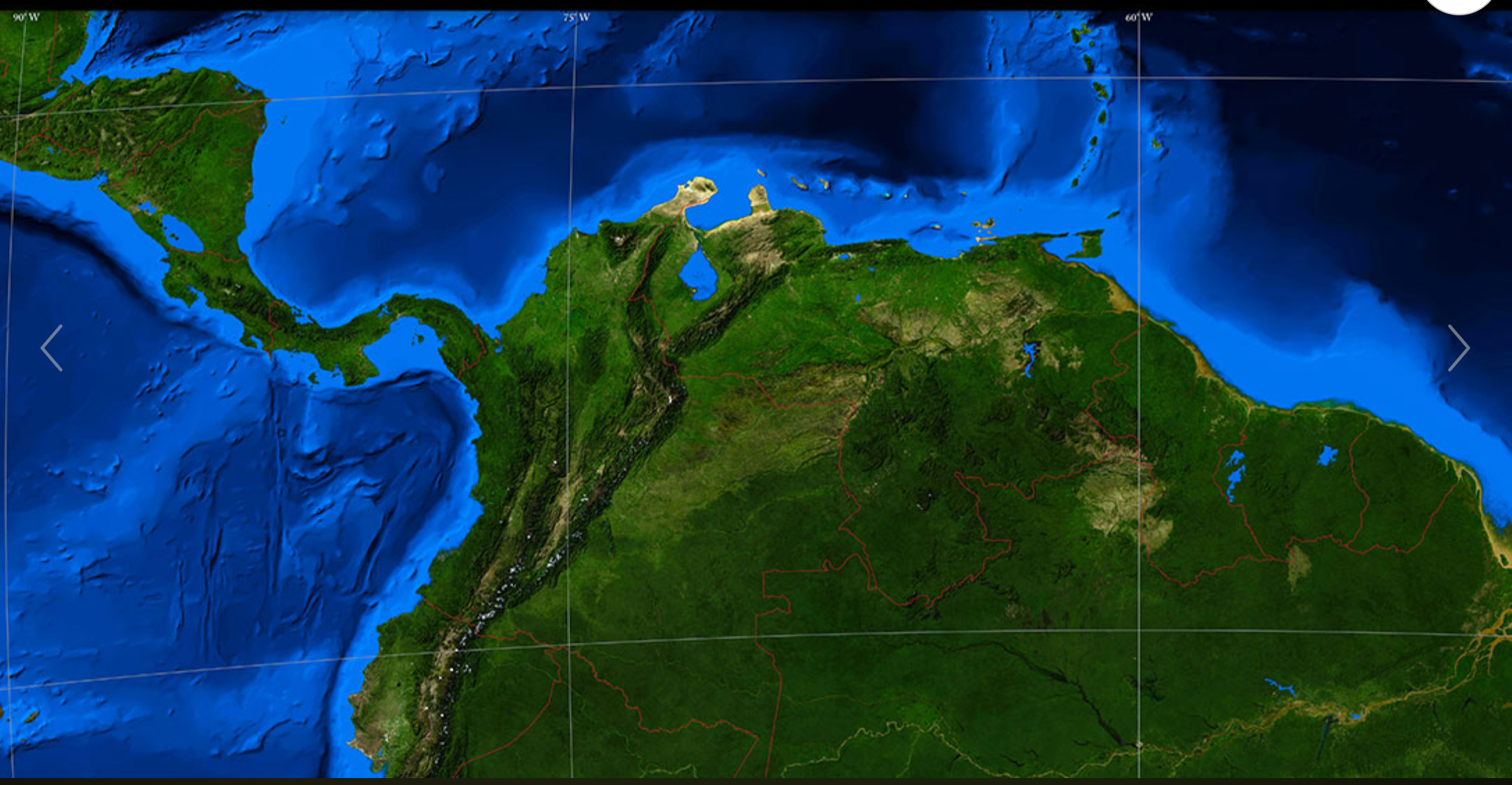
Front Media: (World Maps Online), “Satellite composite map of South America in August” (Projection: Lambert Azimuthal Equal Area; Land imagery: NASA’s MODIS; Ocean bathymetric: GEBCO.)

Accessed 2022 for Educational/Creative Commons Use from: Worldmapsonline.com, “South America Satellite Image Map – Topography & Bathymetry. Code: 1W-SA2-SAT1. Link: https://www.worldmapsonline.com/south-america-satellite-image-map/.

Our Staff


Our staff of founders, researchers, and alumni network, past and present


Founders


Francois Vigier
Mona Serageldin
John Driscoll


STAFF

Carlos Rufin
John Driscoll
Alejandra Mortarini
Carolina Morgan-Hollmann
Maria Luisa Mansfield
Daniel Tsai
Barbara Summers
Rachael Allen

Alumni and Network


Samir Abdulac
Ian Chodikoff
Eban Forbes
Johan Friedl
Sheelah Gobar
Erick Guerra
Warren Hagist
Liviu Ianasi
James Kostaras
Ali Kural
Megan Yeo


Maren Larson
Christa Lee-Chuvala
Kendra Leith
Andrei Luncan
Oriol Manfort
Ricardo Puerta
Linda Shi
Elda Solloso

Januz Szewczuk
Luis Valenzuela


Our Staff

Carlos Rufin, I2UD President – Ph.D. Public Policy (Harvard Kennedy School), M.A. Economics (Colombia University), B.A. Economics (Princeton)

Carlos Rufin is a multi-faceted professional with advanced training in economics and public policy analysis, and extensive experience in the provision of urban utility services in the Global South. He has worked on numerous projects related to infrastructure development, public-private partnerships, renewable energy, electricity markets, and regulatory reform and governance. Having studied public infrastructure systems in many international contexts, he has sought to increase access to primary services for communities living in under-serviced areas.

Carlos combines his practice-oriented work with academic activity, teaching and conducting research on infrastructure-related governance in developing countries, multi-stakeholder partnerships, the interaction between business and informal institutions, and sustainable urbanization. A talented collaborator, he has worked with a wide variety of organizations around the world, such as the World Bank, the Inter-American Development Bank, the Government of Panama, the United States Agency for International Development, and many private companies. In addition, he is the author of several books and numerous articles, and has been a guest speaker at many events and universities in the Americas, Europe, and Asia.

At I2UD, Carlos is currently co-leading the development of AI Climate Platform, an innovative solution for climate change at the intersection of machine learning, poverty, and territorial planning for secondary and rapidly urbanizing cities in the Global South.


John Driscoll, Vice President – BA (University of Maryland), MA (American University), AICP

Sitting in Mona Serageldin’s kitchen in 2005, John, Mona, and Francois Vigier committed to founding  I2UD and continuing their decades-long collaboration at the Harvard Graduate School of Design. John served as an I2UD Vice President until 2021. As a senior staff member, he had a reputation for being patient and persistent and for developing results-oriented programs by empowering local leadership through education, research, and technical support. Reflecting I2UD’s approach, he brought together and managed strong teams of local and outside experts to help development agencies and local governments adopt and implement participatory, integrated policies for urban development. His 35 years of international experience include active field-based engagement with central and local governments, community organizations, educational institutions, and international development agencies such as the World Bank, USAID, and the Agence Française de Développement, and the European Union, among others. With Frank, Mona, and Daniel Tsai, John encouraged and supported I2UD’s young professionals to further their careers, including many who when on to advanced degree programs.

He is an affiliate at the National Center for Smart Growth and Education at the University of Maryland, serves on the Planning Commission in Lexington Virginia, and is actively engaged in urban research programs with the World Bank. [top]

Alejandra Mortarini, Vice President and Treasurer – MUP (Harvard), MBA (Universidad Austral), Architecture (Universidad de Belgrano) 

At the Institute for International Urban Development (I2UD), Alejandra Mortarini is currently co-leading the development of the AI Climate Platform, an innovative solution for climate change at the intersection of machine learning, poverty, and territorial planning for secondary and rapidly urbanizing cities in the Global South.  With the support of the Patrick J Mc Govern Foundation Accelerator Grant, Alejandra is advancing an AI Climate Platform aimed at using machine learning (ML) to identify socially vulnerable areas and to predict and map flooding hazards, landslides, and land values in Honduras. 

Previously at I2UD, Alejandra led a study on the impacts of climate change on informal settlements in Cartagena, Colombia, and Condega, Nicaragua, and their land policy implications. She also worked as a senior planner in nine South African townships developing strategies and sustainable urban plans and designing impact projects to foster social integration, economic development, and environmental health in the Municipalities of Emfuleni, Ladysmith, and Lesedi. She was also a senior planner in the development of Urbanization Strategies and Urban Development Plans for the Municipality of Arusha, Tanzania, as well as in cities in Egypt, Syria, and Latin America.

Prior to her work with I2UD, she served as the Latin America and the Caribbean Program Manager at the Lincoln Institute of Land Policy, where she was responsible for operations and implemented more than 100 programs. Other roles include project management in India with Sasaki Associates and community task-force facilitation (HUD-COPC Grant) at the University of Massachusetts.

Her more than twenty years of urban land policy and planning work have encompassed collaboration with multilateral organizations and foundations, cities, and not-for-profit organizations in Latin America, Africa, the Middle East, and the US. Her leadership style is hands-on, based on participatory approaches, active listening, and centered on collaborating with local and international partners and clients.


Daniel Tsai, Senior Associate and Fellow, and Board Member – BS (MIT), MS (Columbia), MDes (Harvard), DDes (Harvard)

Daniel Tsai is a senior associate/fellow (2005-present) and board member (2012-present). He teaches and conducts research at the MIT School of Architecture and Planning. Over the past 10 years, he has co-instructed the MIT Design Computation Workshop on Digital Heritage, investigating visualization technologies for architectural heritage projects in Italy, Japan, USA and other locales.

At the I2UD, Daniel has worked on the Jerusalem Monuments Database, the I2UD Digital Library, Arusha urbanization strategy and urban development plan, and other technical and quantitative spatial projects.


Rachael Allen, Archivist – MS Library Science (Simmons University), BA History (Simmons University)

Rachael Allen is an archivist in the Greater Boston area. She joined the I2UD team in 2018 to jumpstart the cataloging and digitization of the Institute’s records, and stayed on to bring the project to completion in the form of publicly-available digital collections of I2UD’s photographs and reports. She also worked to inventory and digitize the extensive professional papers and photograph collection of Dr. Mona Serageldin, resulting in the Mona Serageldin Digital Archive.

Allen earned her M.S. in Library and Information Science with a concentration in Archives Management from Simmons University in 2019, where her studies focused on metadata, records management, digital collections, and preservation. Her work as an archivist centers on creating and managing metadata for both analog and digital media, as well as the technical and theoretical processes of digitization to create accessible digital collections.


Former Board Members


I2UD has been fortunate to be supported by Board members and advisors whose financial sponsorship and expertise contributed to our ability to undertake independent research, participate in international networks and support our educational mission.

Noted below are former Board members whose support we sincerely appreciate. 


John M. Sanger, Board President – Esq., BA (Harvard), JD (Harvard), MCP (Harvard)

Sanger is retired from law practice as the founding principal and sole remaining shareholder of the San Francisco law firm of Sanger & Olson, A Law Corporation, which he closed at the end of 2013 after 18 years. He now manages family real estate and engages in philanthropy.  His law firm specialized in real estate law, including land use, environmental clearances and development entitlements.  Prior to founding Sanger & Olson he was with the firm of Pettit and Martin for 10 years and prior to that he had his own urban planning, economic and environmental consulting firm for 14 years, providing services to private and governmental clients. During his years as an active member of the bar, Mr. Sanger was listed in the Northern California edition of Super Lawyers.

He graduated from Harvard College magna cum laude in 1965, from Harvard Law School magna cum laude in 1969, and from the Harvard Graduate School of Design with distinction in 1970, with a Masters in City and Regional Planning.  He has been an Adjunct Professor in Subdivision and Land Development at the University of Miami Law School Graduate Program in Real Property (1993-95), Lecturer in City Planning and Government Organization at the University of California, Berkeley (1974, 1977), and Lecturer in Law, Planning and Urban Politics at San Francisco State University (1979-1980).  He was senior legal advisor to the Republic of Kazakhstan on the privatization of real estate, working through the US Agency for International Development from 1992 to 1994.

Mr. Sanger is a trustee emeritus of the San Francisco Art Institute, having previously served as trustee and chair for many years. He is a founding member of the Board of Trustees and Executive Committee of the Institute for International Urban Development in Cambridge, Massachusetts. He formerly served as President of the Children’s Creativity Museum at Yerba Buena Gardens. He is also a member of Lambda Alpha, a former member of the Urban Land Institute and the American Planning Association and he has served on the boards of a number of local nonprofit organizations.  He was formerly a member and President of the San Francisco Public Utilities Commission and a member of the Executive Board of the Association of Bay Area Governments. [top]

Joe Brennan – BS in Marketing, University of Maryland

In 1974, Mr. Brennan opened up his own construction/development company at the age of 25. His company has become the most successful high-end housing developer in Toronto, completing well over 500 houses ranging from $2,500,000 to $25,000,000 in construction value. In 1995 he opened an office in Palm Beach, Florida. The company has completed many notable projects, including the former Kennedy Winter White House and the Firestone Estate, which won the coveted Ballinger Award for historic preservation. His company has matured to a point where he would like to give back to the community using the skills and experience he has developed in the industry during the last 29 years, with an interest in Poland. [top]

Nadia Beiser, BA in Urban and Regional Planning (Clark University), M.Arch. (Harvard) 

Nadia Beiser has served as a developer, construction project manager, architect, and land use planner. As a self-employed real estate developer in Bozeman, Montana, Ms. Beiser started her design firm in 1980 and completed over 25 solar-heated residential projects, plus numerous state-building renovations to increase energy conservation or permit handicapped accessibility. In addition, Nadia has been responsible for planning, developing, developing, constructing, and marketing numerous residential, commercial, industrial, and mixed-use subdivisions. 


Gary Haney, B.E.D. (Miami University), M.Arch. (Harvard)

 As a Design Partner at the New York office of Skidmore, Owings & Merrill LLP,  Mr. Haney’s design approach incorporates extensive materials research, environmental simulations, and computational scripting. This research-intensive approach enabled him to design buildings of significant scale and complexity. These include the Qatar Petroleum headquarters complex in Doha, Qatar, Al Rajhi Bank Headquarters in Riyadh, the Al Hamra Tower in Kuwait City, and the Al Sharq Tower in Dubai, which was honored with a 2007 Progressive Architecture award. Mr. Haney also completed the LEED-certified U.S. Census Bureau Headquarters, which has won more than ten major design awards, and the $85-million redesign of the Smithsonian’s National Museum of American History, which reorganized and renewed this renowned institution. He has served on numerous advisory boards, including the Pratt Institute and Miami University of Ohio’s Department of Architecture and Interior Design, and led design studios at NJIT, Miami University, and Ball State University.


Aziza al-Hibri, BA in Philosophy (American University of Beirut), Ph.D. in Philosophy (University of Pennsylvania), JD (University of Pennsylvania Law School) 

Azizah Y. al-Hibri is Professor Emerita at the University of Richmond Law School, having served on the faculty from 1992 until her retirement in 2012. Her work centered on developing an Islamic jurisprudence and body of Islamic law that are gender equitable and promote human rights and democratic governance. She has written extensively on issues of Islamic culture and law, approaches to democracy, and human rights in Islam and is internationally active in exploring the possibilities of cooperation with various women’s issues in developing countries. She has lectured in numerous countries on Islam, democracy, women’s rights, and Muslims in the United States. In addition, professor al-Hibri has traveled worldwide to support Muslim women’s rights and programs directed to women to improve urban management and development. She has also served on boards of numerous non-profit organizations and received awards from: Virginia First Freedom Award, Council for America’s First Freedom (2007), Dr. Betty Shabazz Recognition Award, and Women in Islam (NY), 2006.


Roger Kallman, B.Arch (Miami University), MAUD. (University of Minnesota), MRP (UNC) 

For the Skidmore, Owings & Merrill London’s Planning Studio, Roger Kallman was a Consulting Partner for all urban and regional planning studies and planning issues concerning architectural projects. His work encompassed land planning, urban design, transportation planning, new town and campus planning, feasibility studies, environmental assessments, historic preservation, and adaptive reuse. Before this work, he undertook the role of resident SOM representative for the Dublin Transportation Centre study. He lived in Cork while leading the preparation of the Greater Cork Area Land Use/Transportation Plan. The Planning Institution of Ireland recognized his contribution to the Greater Cork Area by electing him an Honorary Life Member in 1996. In addition to his work in Europe, Roger engaged in projects worldwide for both public and private sector clients. He served as Senior Planner for the Chicago Central Area Plan and on numerous projects in the Far East, Central Asia, and the Middle East.


Aline Kradjian, BS. Urban Planning (Cal Poly, Pomona), MRED (USC), AMDP (Harvard)

Kradjian is the Founder of The ARD Group in Costa Mesa, California. The firm specializes in the development of affordable and market-rate ownership housing. Her real estate practice entails evaluating market conditions, analyzing real estate proposals, raising capital, and overseeing all aspects of the development process for the company. Aline has served on and chaired numerous boards and commissions in Los Angeles, such as Historic Preservation, Design Review, and Workforce investment.


Mary Jane Lawson, BA in History and Businesses (Andrews University)

Mary Jane Lawson is the Owner and President of M.J. Lawson Real Estate Ltd., in Toronto, Canada, where she specializes in selling and leasing commercial real estate investments. She has worked in transitional neighborhoods where her marketing expertise has contributed to revitalizing or repurposing under-utilized urban buildings. Projects have included the Ontario Design Center, which transformed an outdated drug supply warehouse into Ontario’s first large-scale commercial center for interior design. She also marketed one of Toronto’s iconic landmarks, The Flat-Iron Building, in Toronto’s famous St. Lawrence Market neighborhood. Mary Jane also worked with developers to rebrand and market a former piano factory into a vibrant office complex known as Studio City. In addition, Ms. Lawson has contributed her marketing expertise to various community groups, including the Toronto Philharmonia. During her time as a member of the Board of the Philharmonia, she rebranded the organization, developed new marketing materials, and was a planning committee member for the annual fundraiser – the famous Viennese Ball. Mary Jane is an American citizen who immigrated to Canada 25 years ago after graduating with a BA in History and Business from Andrews University in Michigan, USA.


Neil St. John Raymond, BA (Yale), M.Des. (Harvard)

Ted Raymond led the Raymond Property Company in Boston, Massachusetts and developed and managed real estate in the Boston area and elsewhere for over 36 years. The firm was engaged in restoration and adaptive use projects and newly constructed developments, for which he won numerous awards. These include awards from the Boston Society of Architects, the Victoria Society of America, the American Institute of Architects, the American Society of Landscape Architects, and the National Trust for Historic Preservation. Trained as an architect at Yale and Harvard, Raymond has extensive experience in the public process and imaginative conceptual solutions to complex projects. He was also a lecturer in various Real Estate courses at the Harvard Graduate School of Design.


Clemens Sels, Agricultural Science (University of Bonn, Germany) Economics, (University of Cologne, Germany) 

Clemens Sels does not follow the conventional rules of property development. He prefers an economically, socially, and environmentally sustainable approach and is not afraid of challenges in this business. Twenty-six years ago, he started with one building for a small group of European clients and expanded his company to three offices with over 40 employees. He is the President of CTL Group, which is active in the development, management, syndication and financing of real estate investments in Canada, with over 120 commercial and residential properties under its management. Clemens is an innovative developer interested in discovering and preserving historic buildings and has successfully revitalized forgotten downtown properties into economically viable projects. He advocates a balanced approach to development and pioneered the design of the first sustainable office tower in Toronto.


Ismail Serageldin, B.S. (Cairo University), MRP (Harvard), Ph.D. (Harvard)

Serageldin was the first Director of the Library of Alexandria in Alexandria, Egypt, a distinguished University Professor at Wageningen University, the Netherlands, and serves as chair and member of many advisory committees for academic, research, scientific and international institutions, and civil society efforts. He worked in different capacities at the World Bank since joining in 1972: Economist in Education and Human Resources (1972-76); Division Chief for Technical Assistance and Special Studies (1977-80), and for Urban Projects in Europe, the Middle East and North Africa (1980-83); Director for Programs in West Africa (1984-87); Country Director for Central and Occidental Africa (1987-89), Technical Director for all Sub-Saharan Africa (1990-92), and Vice-President for Environmentally and Socially Sustainable Development (1993-98). In addition, he was active in promoting NGO-Bank relations and served as Co-Chairman of the NGO-Bank Committee (1997-99). He has edited or authored over 45 books, monographs and 200 articles, book chapters, and technical papers on various topics.


Donate

Giving to the Institute

I2UD is primarily funded through sponsored activities, such as technical assistance, research and executive education programs. Twenty-five percent of our funding comes from gifts and board member contributions, which support our technical assistance activities, in-house research and participation in international networks. If you would like to make a tax-deductible gift to the Institute, please click on the “Donate” button below.

It is you who makes the difference.

Payment Options

Credit Card

Please download our PDF contribution form.  

OR click here to donate online via Paypal
(an account is not required):  

Personal Check

Please make checks out to: “Institute for International Urban Development” and mail to: 

Alejandra Mortarini
Institute for International Urban Development
20 Cogswell Avenue
Cambridge, MA 02140 USA   

Once we receive your donation, we will mail you a receipt for your tax-deductible charitable donation. You may be able to double or even triple your gift to I2UD if your company matches employees’ charitable giving. For additional information, please contact Alejandra Mortarini at office.i2ud@gmail.com 

Thank you for your generous support of the Institute!